
Short answer: a new yacht delivery moves a brand-new boat from the shipyard or dealer to the owner’s home port or charter base. It starts with commissioning and a sea trial at the yard, continues with a careful passage that runs in the new engine and settles the rig, and ends with a handover and a snag list for the warranty. Done properly, the delivery is the yacht’s shakedown cruise: problems are found by a professional crew close to the factory, not by the owner on the first family holiday.
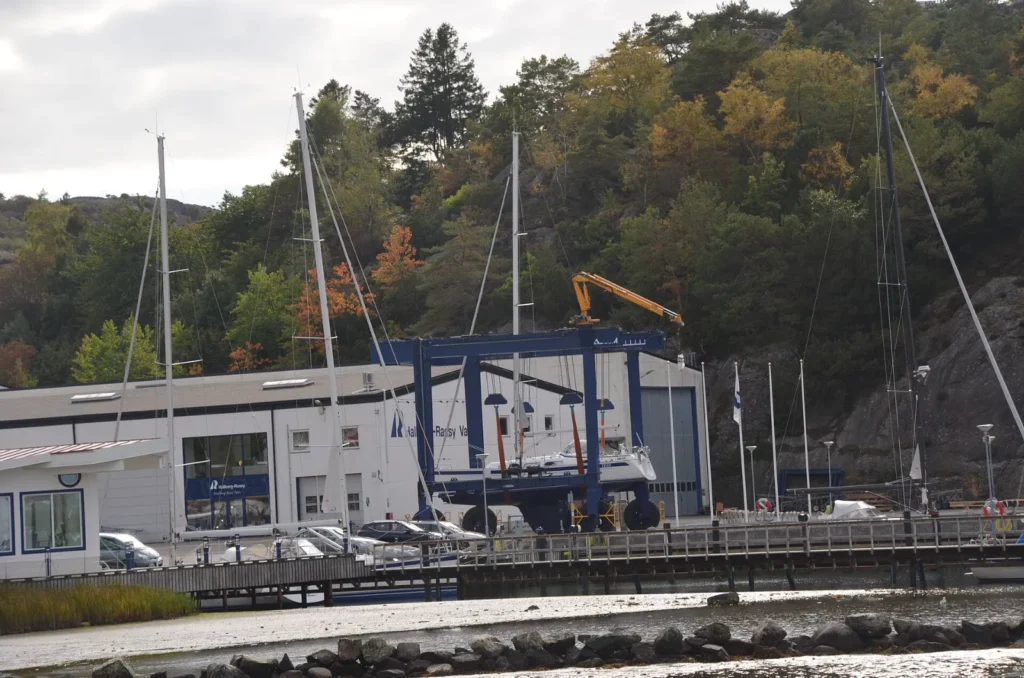
Many of Europe’s best-known yachts are built in the north — in Denmark, Sweden, Finland and Germany — while many owners keep their boats in the Mediterranean. Others are built in France, the UK or Italy and sold all over Europe. Either way, a new yacht usually has a long way to go from the factory to its home port. This guide explains how a professional crew delivers a new yacht and what owners should prepare.
Where new yachts start their journey
| Country | Examples of yards and regions | Typical first leg |
|---|---|---|
| Denmark | X-Yachts in Haderslev | Little Belt → Kiel Canal or the Skagerrak |
| Sweden | Hallberg-Rassy and Najad on the island of Orust | Skagerrak → North Sea, or south into the Baltic |
| Finland | Nautor Swan in Jakobstad (Pietarsaari) | Gulf of Bothnia → Baltic Sea, a long first leg |
| Germany | Hanse in Greifswald; Bavaria builds inland and trucks its boats to the water | Baltic → Kiel Canal → North Sea |
| France | Beneteau and Jeanneau in the Vendée; La Rochelle and Bordeaux for many catamarans | Bay of Biscay → Spain, Portugal and Gibraltar |
| UK and Italy | Large motor yacht builders on the English south coast and in northern Italy | Channel or Mediterranean, with customs when crossing the UK–EU border |
From the Baltic yards, most deliveries south follow the route in our Scandinavia to the Mediterranean guide, often through the Kiel Canal.
Step 1: commissioning at the yard or dealer
A new yacht is not ready to sail the day it leaves the factory floor. Commissioning usually includes stepping and tuning the mast, bending on the sails, setting up the electronics, checking the engine, filling fluids and testing every system. A good commissioning is the foundation of a smooth delivery, so we like our skipper to be there for the last part of it.
Step 2: the sea trial
Before departure, the yacht is tested on a sea trial with the yard or dealer: the engine at different loads, steering, autopilot, sail handling, bilge pumps, navigation lights, charging and instruments. Anything that does not work goes on a list for the yard to fix before the yacht leaves — it is far easier to fix at the yard than in a foreign port.
Step 3: paperwork for a new yacht
- Registration — the yacht must be registered, or temporarily registered, under a flag before an international passage.
- CE documentation — the Declaration of Conformity and the owner’s manual under the EU Recreational Craft Directive, including the design category: A (ocean), B (offshore), C (inshore) or D (sheltered waters). The category should suit the route.
- VAT invoice — proof that VAT has been paid, or the correct export paperwork.
- Insurance from the moment the owner takes responsibility, covering the route and a professional crew.
- Radio licence and an MMSI number for the VHF and AIS.
Our insurance checklist explains what to ask your insurer.
Step 4: running in a new engine
New diesel engines need a sensible running-in period. The manufacturer’s manual always comes first, but the idea is usually the same: vary the engine speed, avoid long periods at idle, avoid long runs at full load, and change oil and filters at the hours the manufacturer specifies. On a motor yacht, the first delivery is also the moment to confirm the real fuel consumption — see our guide to fuel and range planning.
Step 5: settling the rig and sails
New standing rigging stretches slightly in the first sea miles, and new sails need time to take their shape. A professional crew checks the rig tension after the first sailing days, looks over every split pin, shackle and furler, and reports anything that needs a rigger’s attention at the destination.
Step 6: the snag list and warranty
A delivery of several hundred miles is the most thorough test a new yacht gets in its first months. Our skippers keep a snag list: small leaks, loose fittings, electronics faults, chafe points and anything that does not work as designed, with photos and engine hours. The owner can send it straight to the yard or dealer as a warranty claim. Our handover guide shows what you receive at the destination.
Sail it or ship it?
Most new sailing yachts and catamarans are delivered by sea. A large motor yacht crossing an ocean, or a boat with a tight deadline for a boat show, may be better shipped, and road transport from the factory works for smaller boats. We compare the options in our article on moving a sailboat by sea, road or ship.
How long does a new yacht delivery take?
From the Baltic yards to the western Mediterranean, a sailing yacht typically needs three to five weeks including stops, depending on the weather, the size of the yacht and the stops for fuel and rest. Add time for commissioning, the sea trial and yard delays — new boats are often finished later than planned. The best months for each route are in our delivery calendar.
New yacht delivery with Nordic Crew Worldwide
We are a Scandinavian team, close to the Scandinavian yards, with a base in Málaga at the other end of the route. Our captains come from the commercial maritime fleet and treat a new yacht as what it is: the owner’s long-awaited investment. We can join the commissioning, take the yacht through its sea trial, deliver it to its home port and hand it over with a full report. Ask for a delivery quote or meet our captains.
Related guides
Frequently asked questions
Who delivers a new yacht from the shipyard?
Usually the dealer arranges commissioning, and the owner or dealer hires a professional delivery crew to take the yacht from the yard to its home port. Some owners join the crew to learn the boat.
What is commissioning on a new yacht?
The work that turns a factory-finished boat into a yacht that is ready to sail: stepping and tuning the mast, fitting sails and electronics, checking the engine and testing all systems, followed by a sea trial.
Does a delivery affect the warranty on a new yacht?
A professional delivery that follows the manufacturer’s instructions, including engine running-in, normally does not, but always check the warranty terms. A good crew also documents defects during the passage, which supports warranty claims.
What do design categories A, B, C and D mean?
Under the EU Recreational Craft Directive, category A is designed for ocean conditions, B for offshore, C for inshore waters and D for sheltered waters. The route of a delivery should match the yacht’s category.