
Short answer: there are three ways to move a sailing yacht or a large motorboat over long distances in Europe: delivery by sea with a professional crew, road transport on a trailer or low-loader, and shipping on a cargo vessel. For most yachts over about 10 metres moving along Europe’s coasts, a sea delivery is the most practical and often the cheapest option. Road transport suits smaller boats and inland destinations, but anything wider than 2.55 m is an oversize load that needs permits. Shipping is best for ocean crossings, tight deadlines or motor yachts without the range for a long passage.
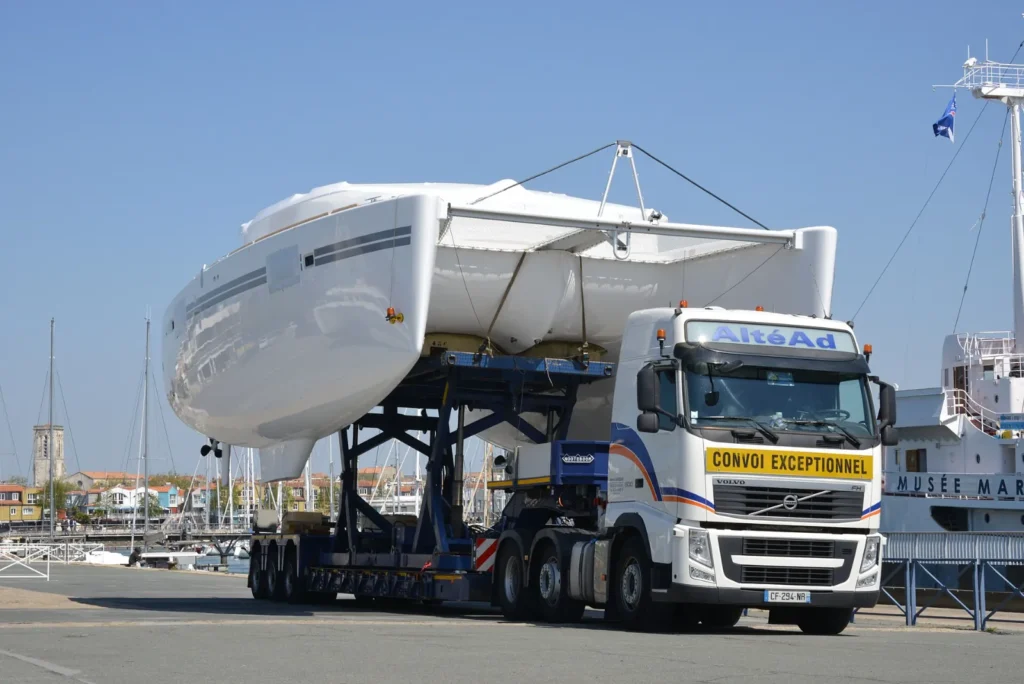
“What is the best way to transport a sailboat in Europe?” is one of the most common questions we get. The honest answer depends on the boat, the distance, the deadline and the budget. This guide compares the options side by side.
The three options compared
| Sea delivery (crew) | Road transport | Shipping (cargo vessel) | |
|---|---|---|---|
| Best for | Most yachts along European coasts and across oceans | Smaller boats, inland or lake destinations | Ocean crossings, motor yachts with limited range, tight deadlines |
| Size limits | None in practice | Width over 2.55 m = oversize load with permits | Set by the ship and loading port |
| Mast and rigging | Stay up | Usually unstepped and secured | Often stays up; depends on the carrier |
| Wear on the yacht | Engine hours and sea miles | None at sea, but lifting and road vibration | None at sea, but lifting and cradles |
| Flexibility | Any port to any port | Door to door | Fixed routes and sailing dates |
| Typical extra costs | Fuel, marinas, crew travel | Permits, escorts, crane and mast work | Port fees, lifting, cradle, loading agent |
Option 1: delivery by sea
A professional skipper and crew sail or motor the yacht to its destination. In Europe this is the most common choice for yachts above trailer size, because the coastline and the inland waterways link almost every country: the Kiel Canal joins the Baltic and the North Sea, and the English Channel, the Bay of Biscay and the Strait of Gibraltar lead to the Mediterranean.
- Pros: no size limits, no lifting, mast stays up, any port to any port, and the yacht is tested and used on the way.
- Cons: depends on weather windows, adds engine hours and sea miles, and the yacht must be seaworthy.
Read our preparation checklist and yacht delivery in Europe guide.
Option 2: road transport
The yacht is lifted onto a trailer or low-loader, usually with the mast unstepped. In the EU the normal maximum vehicle width is 2.55 m. Most cruising yachts are wider, so they travel as an exceptional load: permits in every country on the route, restricted driving times and, for wide loads, escort vehicles.
- Pros: door to door, independent of sea weather, ideal for lakes and inland marinas.
- Cons: cost rises steeply with width and height, permits take time, and the mast and rigging must be taken down and put up again.
Option 3: shipping on a cargo vessel
Specialist yacht carriers and general cargo ships load yachts on deck in ports such as those in the Mediterranean, Northern Europe and the Caribbean.
- Pros: no ocean miles on the yacht, fixed arrival windows, good for motor yachts that cannot cross an ocean on their own fuel.
- Cons: fixed routes and dates, lifting and cradle risk, and the yacht still needs to be delivered to the loading port and collected at the other end — often by a delivery crew.
For more detail, read yacht delivery vs. boat transport.
The best way to move a large motorboat long distances
For a large motor yacht, range decides. Along Europe’s coasts, a sea delivery with planned fuel stops is usually the best option. For an ocean crossing, shipping is usually safer and cheaper than carrying extra fuel. See our motor yacht fuel and range guide.
How to choose: a quick decision guide
- Boat under about 2.55 m wide and going inland? Road transport is often simplest.
- Cruising yacht moving along European coasts? Sea delivery with a professional crew.
- Catamaran? Its beam makes road transport difficult — sea delivery is usually best. See our catamaran delivery guide.
- Motor yacht crossing an ocean? Shipping, with a crew to deliver to and from the ports.
- Hard deadline in another season? Ask for both a delivery and a shipping quote and compare.
Get a quote for your yacht
Nordic Crew Worldwide delivers yachts by sea across Europe and the Atlantic, and we help owners compare sea delivery with transport when that makes more sense. Request a free quote, read how pricing works or see our services.
Related guides
- Yacht Delivery by Sea vs. Boat Transport by Road or Ship
- Yacht Delivery in Europe: Routes, Seasons and Paperwork, Country by Country
- Motor yacht fuel and range planning
Frequently asked questions
What is the best way to transport a sailboat in Europe?
For most cruising yachts moving along European coasts, delivery by sea with a professional crew is the most practical option. Road transport suits smaller boats and inland destinations, and shipping suits ocean crossings.
How wide can a boat be for normal road transport in the EU?
The standard maximum vehicle width in the EU is 2.55 metres. Wider boats travel as exceptional loads with permits, restricted driving times and sometimes escort vehicles.
What is the best way to move a large motorboat a long distance?
Along Europe’s coasts, a sea delivery with planned fuel stops. For an ocean crossing, shipping on a cargo vessel is usually safer and cheaper than carrying extra fuel.
Is it cheaper to sail or ship a yacht?
Within Europe, a sea delivery is usually cheaper. For ocean crossings it depends on the yacht: shipping often wins for motor yachts, while a sailing yacht crossing in season is often cheaper to deliver by sea.