
Short answer: a catamaran delivery is planned much like a monohull delivery, with a few important differences. A cat’s beam limits which marinas, travel lifts, canals and transport options you can use. Because a cat does not heel to warn you of too much sail, you reef by wind speed and early. You also manage bridgedeck slamming in head seas, keep the boat light, and check two of everything — two engines, two saildrives, two rudders. Done right, a well-found cruising catamaran is a fast, comfortable boat to deliver. Below is how a professional crew moves a cat safely.
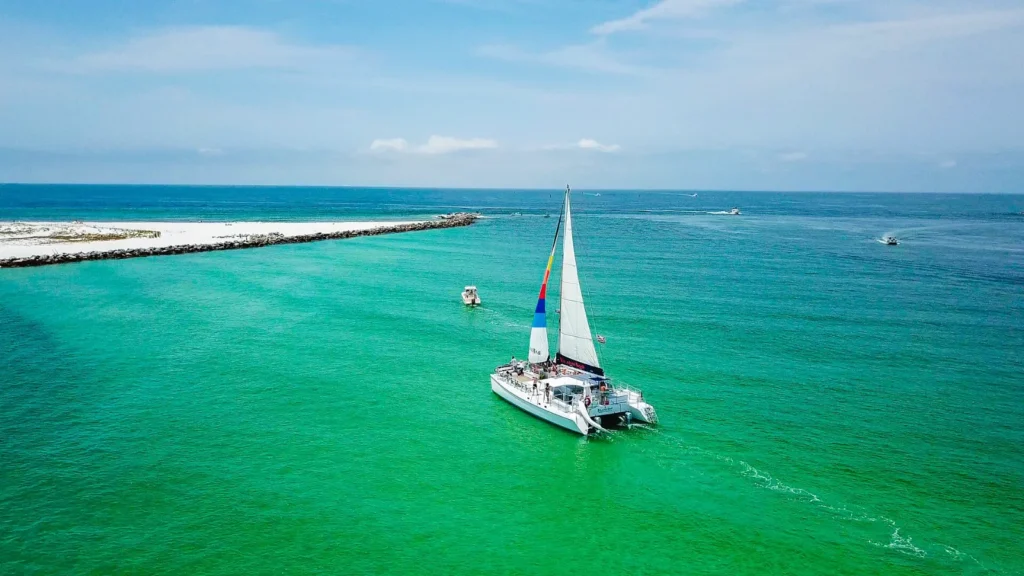
Catamarans are now a large share of the cruising and charter market, and many are moved from the builder to their first base — or from the Mediterranean to the Caribbean for the winter season. This guide explains what a delivery crew does differently on a cat.
Catamaran vs. monohull delivery: what changes
| Factor | Monohull | Catamaran |
|---|---|---|
| Stability | Ballast; heels and rounds up as a warning | Form stability; stays flat, so overpressing is less obvious |
| Reefing | Often by heel angle and feel | By apparent wind speed, using a reefing table |
| Beam | Fits standard berths and lifts | Often 7–8 m or more; wider berths, special lifts |
| Head seas | Pitches and pounds | Waves can slam under the bridgedeck |
| Weight | Less sensitive to load | Performance and bridgedeck clearance suffer when overloaded |
| Systems | One engine, one shaft or saildrive | Usually two engines, two saildrives, two rudders |
Beam: berths, lifts, canals and transport
- Marina berths: many marinas charge catamarans a surcharge, often around 1.5 times the monohull rate, and wide berths must be booked early in the high season. This affects the cost of a delivery with several stops.
- Haul-out: not every boatyard has a travel lift wide enough for a cruising cat. Check before planning any repair stop.
- Canals and bridges: the Kiel Canal is no problem, but inland routes can be. On the Dutch Standing Mast Route, for example, the Kaagbrug limits boat beam to 8.00 m on the western route — and in 2026 large parts of that route are closed anyway.
- Transport: a cat’s beam makes road transport a wide load with permits and escorts, and shipping more expensive. That is why delivery under its own sail is often the best option. Read yacht delivery vs. boat transport.
Sail handling and heavy weather
- Reef early, by the numbers. A catamaran stays flat while the loads on the rig keep rising. Follow the builder’s reefing table based on true or apparent wind speed, and reef well before you need to.
- Reefing downwind is hard. With the wind behind, the main is pressed against the rigging and will not come down easily. An experienced crew reefs in good time before the wind rises.
- Headsail first for control. Shortening the headsail is quick and safe. Start the leeward engine before reefing or tacking so the boat keeps steerage way.
- Keep moving upwind. If a catamaran stops head to sea, a breaking wave can push it backwards. That risks rudder damage and, in extreme cases, a stern-first capsize.
- Drogue from the stern. In survival conditions, catamaran sailors generally prefer a drogue (for example a series drogue) set from the stern to slow the boat, rather than a sea anchor from the bow.
- Sheets ready to release. A cruising cat is very hard to capsize, but it will not right itself. Mainsheet and traveller should always be ready to ease.
Bridgedeck slamming
When waves hit the underside of the bridgedeck between the hulls, the slamming is loud, uncomfortable and stressful for the structure. Low bridgedeck clearance and a heavy load make it worse. On a delivery we reduce slamming by:
- easing speed in head seas and bearing away a few degrees;
- keeping weight out of the bows and the boat as light as possible;
- choosing a weather window that avoids long beats into steep seas.
Weight and loading
Catamarans are weight-sensitive. Before a delivery, ask the owner to remove anything not needed for the passage — spare gear, full water tanks you do not need, heavy toys. A lighter cat is faster, slams less and keeps a better margin above the waves.
Two of everything: pre-delivery checks
- Both engines serviced; impellers, belts, filters and coolant checked
- Both saildrives: oil, seals and propellers
- Both rudders, steering cables or hydraulics, and the linkage between them
- Trampoline, forward crossbeam and bridle for the anchor
- Escape hatches and the emergency equipment stowed where the crew can reach it
- Batteries, solar and charging, since cats often carry large house banks and electric systems
See our full yacht delivery preparation checklist.
Typical catamaran delivery routes
- From the builder: many cruising cats are built in France and delivered from the Atlantic coast to the Mediterranean via the Bay of Biscay and the Strait of Gibraltar.
- Mediterranean to Caribbean: the classic autumn trade-wind crossing via the Canaries suits catamarans well. Read our Med to Caribbean guide.
- Back to Europe: the return in spring via the Azores is harder and wetter. See Caribbean to Europe.
- Northern Europe: cats heading to Scandinavia use the North Sea and often the Kiel Canal.
Catamaran deliveries with Nordic Crew Worldwide
We deliver catamarans as well as monohulls. Our crews are matched to the boat: skippers with multihull experience, enough hands for two-engine manoeuvres in tight marinas, and passage plans built around the cat’s beam, berth availability and weather limits. See our delivery packages, read how yacht delivery pricing works, or request a free quote.
Related guides
- Mediterranean to Caribbean yacht delivery
- Yacht Delivery by Sea vs. Boat Transport by Road or Ship
- How to prepare your yacht for delivery
- New yacht delivery from the shipyard
Frequently asked questions
Is a catamaran harder to deliver than a monohull?
Not harder, but different. The crew must reef by wind speed rather than heel, manage bridgedeck slamming in head seas, plan around the boat’s beam for berths and haul-outs, and check two engines and two saildrives.
Why do you reef a catamaran earlier?
A catamaran stays flat instead of heeling, so it gives little warning when it is overpowered while the loads on the rig keep rising. Following the builder’s reefing table by wind speed keeps the rig and the boat safe.
Are marinas more expensive for catamarans?
Often yes. Many marinas charge a surcharge for multihulls, commonly around one and a half times the monohull rate, and wide berths are limited in high season.
Is it better to sail or ship a catamaran?
A catamaran’s beam makes road transport a wide load and shipping costly, so delivery under its own sail is often the most practical and economical option.