
Short answer: the Strait of Gibraltar is only about 8 nautical miles wide at its narrowest, with a constant surface current of roughly 2–3 knots flowing east into the Mediterranean, strong tidal streams on top, and winds that funnel to two or three Beaufort forces above the forecast off Tarifa. Go east into the Med with a light westerly (Poniente) and arrive at Tarifa around high water Gibraltar; go west into the Atlantic with a light easterly (Levante) and time Tarifa for about six hours after high water Gibraltar. Never transit in a strong wind against the tide.
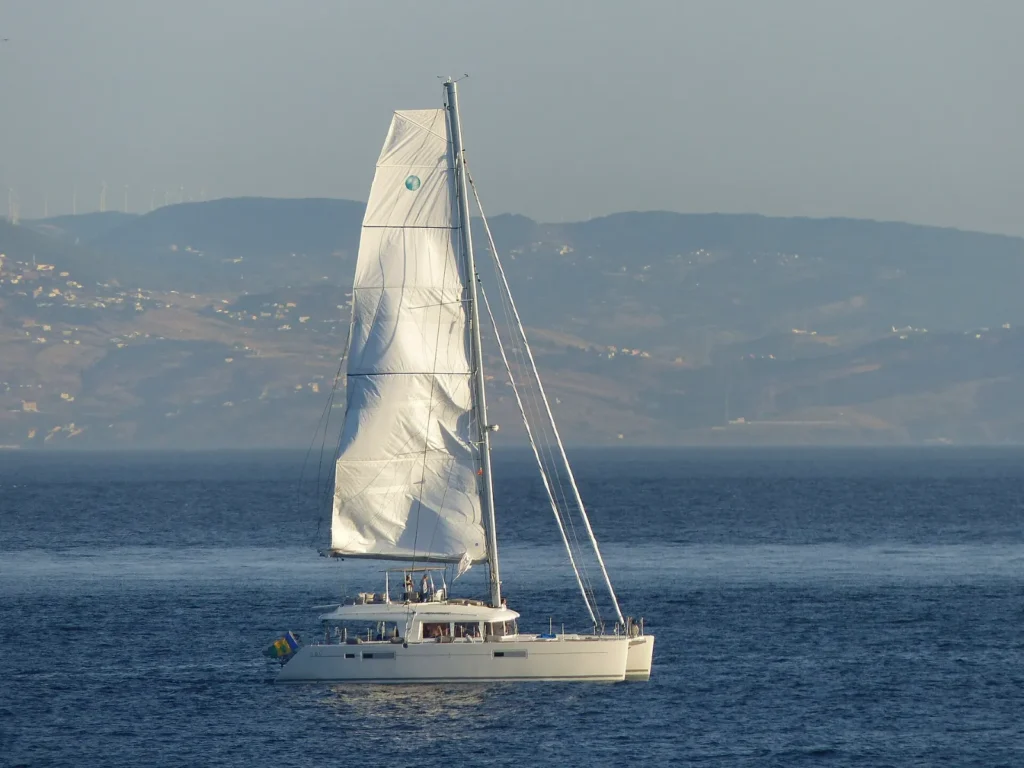
Almost every yacht delivery between Northern Europe and the Mediterranean, and every delivery from the Med to the Canaries and the Caribbean, passes through the Strait. This guide from the delivery captains at Nordic Crew Worldwide — based in Málaga, just east of the Strait — explains how to plan a safe transit in either direction.
Why the Strait is tricky
- A permanent current. Atlantic water is less salty and less dense than Mediterranean water, so a surface current runs continuously east into the Med at about 2–3 knots.
- Complex tides. Atlantic tides are added to that current, producing some of the most complicated tidal streams in Europe, with eddies near the coasts.
- Funnelled wind. The Strait is narrow and steep-sided, so wind blows either east or west — and accelerates sharply off Punta de Tarifa and at the entrance to the Bay of Gibraltar.
- Heavy shipping. Around 300 commercial ships pass through every day, using a traffic separation scheme (TSS) in the middle of the Strait.
- Orcas. Iberian orcas gather in the Strait in spring and early summer, following migrating tuna.
Levante and Poniente: the two winds that decide everything
| Wind | Direction | When most common | Good for |
|---|---|---|---|
| Levante (Levanter) | From the east | Summer, May–September | Leaving the Med westbound into the Atlantic |
| Poniente | From the west / north-west | More frequent October–April | Entering the Med eastbound |
A tell-tale sign of a Levante is a persistent cloud banner over the Rock of Gibraltar, sometimes with sea fog. The safest plan in either direction is to leave with a light or nearly windless forecast — the Strait will add wind of its own.
Eastbound: entering the Mediterranean
- Wait for the right forecast: a light Poniente or calm. Do not go with a strong westerly — the sea off Tarifa becomes dangerous.
- Waiting port: Barbate is the last marina before the Strait, about 20 nm from Tarifa. Cádiz or Rota are alternatives further north.
- Tide: aim to be off Tarifa around high water Gibraltar (HW-GBR). From Barbate, a 44 ft monohull typically leaves about three hours before HW-GBR.
- Be ready to reef before Tarifa and at the entrance to the Bay of Gibraltar, where the wind accelerates.
- African side alternative: boats coming from the Canaries can follow the current along the Moroccan coast from Tangier, leaving about two hours before HW-GBR.
Westbound: leaving the Mediterranean
- Wait for a light Levante. Westbound tidal windows are shorter, because you are working against the permanent east-going current.
- Waiting port: Gibraltar or Alcaidesa Marina in La Línea, about 15–17 nm from Tarifa. Ceuta is popular for boats crossing to the African side.
- Tide: plan to reach Tarifa about six hours after HW-GBR, to use the west-going stream.
- Heading south to the Canaries: many boats cross the TSS at the narrowest point at slack water, then ride the west-going current along the African side.
Shipping and the traffic separation scheme
Stay out of the shipping lanes unless you must cross them. If you do cross the TSS, keep a heading at right angles (90°) to the traffic flow, keep a sharp lookout and use AIS. Tarifa Traffic monitors the Strait on VHF, and Tarifa Radio broadcasts weather in English on VHF channel 10 every two hours.
Orcas in the Strait
Orcas are typically in and around the Strait from spring to early summer, then follow the tuna north along the Portuguese coast. Current advice is to keep inside the 20 m depth contour or well offshore where orcas are reported, and to check the latest reports before every passage. Read our full guide to orca interactions off Spain and Portugal.
Planning tools
- A tidal stream atlas for the Strait (Admiralty or pilot book), showing streams hour by hour relative to HW-GBR
- Two weather models — ECMWF is generally considered the most reliable for the Strait
- Tarifa Radio forecasts on VHF 10
- Current orca interaction reports and maps
The Strait on a professional delivery
From our base in Málaga, the Strait is on our doorstep. On every delivery through it, our captains plan the transit around the tide at Gibraltar, the Levante–Poniente forecast and the latest orca reports, and wait in port rather than force a passage. If your yacht is heading into or out of the Mediterranean — for example on our Scandinavia to Mediterranean route or a delivery to the Caribbean — request a free quote.
Related guides
Frequently asked questions
When is the best time to sail through the Strait of Gibraltar?
Choose a day with light winds. Go east into the Mediterranean with a light westerly (Poniente) and arrive off Tarifa around high water Gibraltar. Go west into the Atlantic with a light easterly (Levante) and reach Tarifa about six hours after high water Gibraltar.
How strong is the current in the Strait of Gibraltar?
A permanent surface current flows east into the Mediterranean at about 2–3 knots, with tidal streams added on top. The combination makes the Strait one of the most complex tidal areas in Europe.
Where do yachts wait for a weather window at Gibraltar?
Eastbound yachts usually wait in Barbate, about 20 nm from Tarifa, or in Cádiz or Rota. Westbound yachts wait in Gibraltar or Alcaidesa Marina in La Línea, about 15–17 nm from Tarifa, or in Ceuta on the African side.
Are there orcas in the Strait of Gibraltar?
Yes. Iberian orcas are typically in and around the Strait in spring and early summer, following migrating tuna. Check the latest interaction reports before every passage.