
Short answer: on a motor yacht delivery, fuel range decides the route. Work out the real consumption at a realistic cruising speed, plan every leg so you arrive with at least 20–25% of usable fuel in reserve, and slow down to stretch range — for displacement boats, around two-thirds of hull speed is often the most economical. Plan fuel stops and weather windows together, carry spare filters for bad diesel, and accept that most motor yachts cannot cross an ocean on their own fuel: for the Atlantic, shipping is usually the answer.
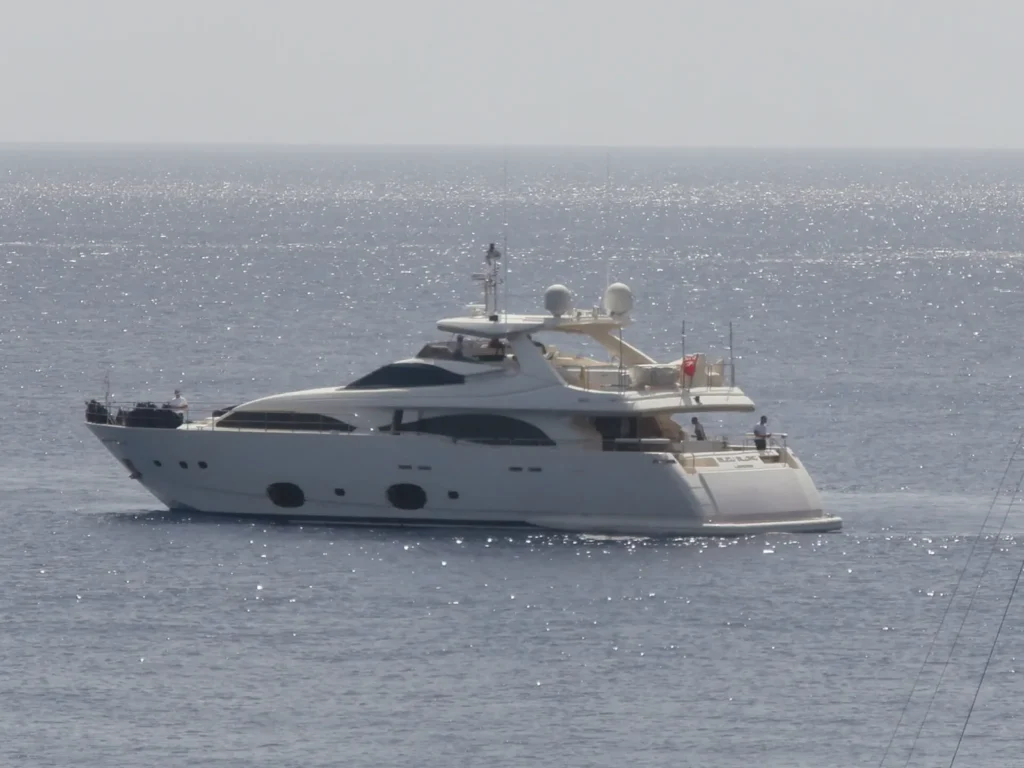
A sailing yacht can always fall back on its sails. A motor yacht has only its fuel and its engines. That is why passage planning for a motor yacht delivery starts with numbers: tank capacity, consumption, speed and distance. This guide explains how professional delivery crews plan range, fuel stops and routes.
How to calculate range
The basic formula is simple:
Range (nm) = usable fuel (litres) ÷ consumption (litres per hour) × speed (knots)
The hard part is using honest figures. Usable fuel is less than tank capacity, because pickups do not draw the last litres, especially in a seaway. Consumption should come from logged data or a fuel-flow meter at the speed you will actually run, not from a brochure. Include the generator, which can burn several litres an hour.
A worked example
| Scenario (illustrative) | Fast cruise | Economical cruise |
|---|---|---|
| Usable fuel | 2,000 L | 2,000 L |
| Speed | 9 knots | 7 knots |
| Consumption incl. generator | 60 L/h | 30 L/h |
| Theoretical range | 300 nm | 467 nm |
| Planned range with 25% reserve | 225 nm | 350 nm |
Dropping two knots in this example adds more than 100 nm of safe range. Real figures vary from boat to boat, so we always use the yacht’s own data.
Why slowing down works
- Displacement hulls have a natural hull speed of roughly 1.34 × √(waterline length in feet) in knots. Close to hull speed, wave-making resistance rises steeply, so each extra fraction of a knot costs a lot of fuel.
- The two-thirds rule of thumb: the best distance-per-litre for a displacement boat is often found around two-thirds of hull speed. Each boat is different, so we test and log it.
- Planing and semi-displacement yachts burn the most fuel in the transition just below planing speed. They are usually run either on the plane in calm water or well below planing speed for range.
Fuel reserve: how much is enough?
Day boaters often use the “rule of thirds”: one third out, one third back, one third in reserve. On a delivery passage, a reserve of at least 20–25% of usable fuel at arrival is a common minimum, and more on legs with headwinds, strong currents or few alternative ports. The reserve is there for the unplanned: a detour around weather, a foul current, or a slower speed in head seas.
Fuel quality and filters
- Fill up at busy, reputable fuel docks where the diesel is fresh.
- Carry plenty of spare fuel filters and know how to change them at sea.
- Check the water separators before departure and during the passage.
- Tanks that have stood for months can grow “diesel bug” and stir up sediment in a seaway — inspect and, if needed, polish the fuel before a long leg.
Engine and systems checks
- Main engines and generator serviced: oil, filters, impellers, belts and coolant
- Gearboxes, shafts, seals and propellers
- Stabilisers, steering and hydraulic systems
- Bilge pumps and high-water alarms
- Electronics: radar, AIS, autopilot and a back-up navigation system
See our full yacht delivery preparation checklist.
Weather: tighter windows than under sail
Motor yachts are comfortable and fast in good conditions, but head seas slow them down and raise fuel burn sharply. Planing yachts in particular need calmer windows. We plan routes along coasts with frequent fuel stops and harbours of refuge, and wait in port rather than burn reserve fuel punching into a gale. Local winds matter too — read our guide to Mediterranean winds.
Long legs and ocean crossings
| Passage | Approx. distance | Feasible for most motor yachts? |
|---|---|---|
| Coastal Europe and Mediterranean hops | 50–200 nm | Yes, with planned fuel stops |
| Gibraltar → Madeira | ~600 nm | Only for long-range yachts |
| Bermuda → Azores | ~1,800 nm | Only for dedicated long-range expedition yachts |
| Cape Verde → Caribbean | ~2,000 nm | Rarely; usually shipped |
For an ocean crossing, shipping a motor yacht on a cargo vessel is often cheaper and safer than adding extra fuel bladders. Read yacht delivery by sea vs. boat transport.
Inland routes for motor yachts
Low air draft is an advantage: many motor yachts can use inland waterways that sailing yachts with a standing mast cannot. Many French canals are built to the Freycinet gauge — locks for boats up to 38.5 m long and 5.05 m wide, a draught of about 1.8 m and bridges with around 3.7 m clearance — so check your yacht’s dimensions against the specific route. Further north, the Kiel Canal is a short cut between the North Sea and the Baltic.
Motor yacht deliveries with Nordic Crew Worldwide
Our team includes a trained mechanic with engine-room experience from the Danish Royal Navy, and our captains come from the commercial fleet, where fuel planning, engine-room routines and watchkeeping are part of daily work. We log consumption from the first hour, plan every leg with a fuel reserve, and keep you updated on position and fuel state. Meet our crew, read how pricing works, or request a free quote.
Related guides
Frequently asked questions
How do you calculate a motor yacht’s range?
Divide usable fuel in litres by consumption in litres per hour at your cruising speed, then multiply by the speed in knots. Use logged consumption including the generator, and subtract a reserve before planning a leg.
How much fuel reserve should a motor yacht keep?
On a delivery passage, plan to arrive with at least 20 to 25 percent of usable fuel left, and more on legs with headwinds, strong currents or few alternative ports.
What is the most economical speed for a displacement motor yacht?
As a rule of thumb, around two-thirds of hull speed. Hull speed in knots is roughly 1.34 times the square root of the waterline length in feet. Each boat differs, so log real consumption.
Can a motor yacht cross the Atlantic on its own?
Only dedicated long-range yachts. Legs such as Bermuda to the Azores are about 1,800 nautical miles, beyond the range of most motor yachts, so shipping is usually the better option.