
Short answer: the Kiel Canal (Nord-Ostsee-Kanal) is a 98 km shortcut between the Baltic and the North Sea, from Kiel-Holtenau to Brunsbüttel. Yachts must motor (sailing is not allowed), keep below 15 km/h (about 8 knots), travel in daylight only and moor only at designated places. Most yachts need a long day or an overnight stop to get through. The current transit fee for pleasure craft is roughly €12–43 depending on length, and from 1 January 2027 recreational craft will be able to use the canal free of charge.
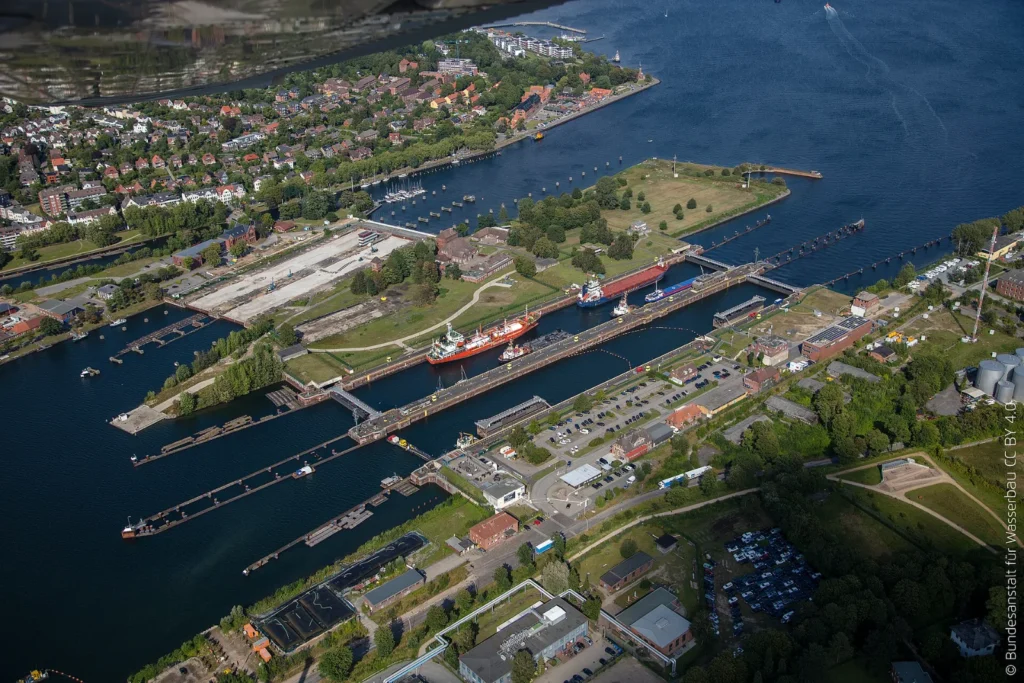
For yachts leaving Denmark, Sweden or the Baltic for the North Sea, the English Channel and onward to the Mediterranean, the Kiel Canal is usually the fastest and most sheltered way out. It avoids the long and often rough passage around Skagen and through the Skagerrak. This guide from the Scandinavian delivery captains at Nordic Crew Worldwide explains how a transit works in practice.
Kiel Canal at a glance
| Kiel Canal for pleasure craft | |
|---|---|
| Length | About 98 km (53 nm) |
| Ends | Kiel-Holtenau (Baltic) and Brunsbüttel (River Elbe / North Sea) |
| Maximum speed | 15 km/h (about 8 knots) |
| Sailing | Not allowed — motor only. Motor-sailing requires the black cone, point down |
| Navigation hours | Daylight only for pleasure craft |
| VHF | Monitor the lock channel when approaching (Kiel-Holtenau: channel 12) |
| Fee | Approx. €12–43 by length; free for pleasure craft from 1 January 2027 |
| Transit time | A long day at 5–6 knots; many yachts split it with an overnight stop |
Kiel Canal or around Skagen?
The alternative from the Baltic is to go north through the Kattegat, round Skagen and cross the Skagerrak into the North Sea. That route is longer and much more exposed — the Skagerrak can build steep, short seas in strong westerlies. The canal gives a sheltered transit and brings you out at the Elbe estuary, well placed for the Dutch coast and the English Channel. For deliveries from Denmark’s east coast, Sweden’s Baltic coast or further east, the canal is almost always our first choice. From western Norway or the west coast of Sweden, going outside can make more sense.
How to transit the Kiel Canal step by step
- Plan the timing. Pleasure craft may only navigate in daylight. Plan where you will stop if you can’t complete the 98 km before dark.
- Approach the locks. Wait in the designated area for small craft and monitor the lock’s VHF channel. Do not enter until the light signals allow it.
- Read the lock lights. At Kiel-Holtenau, a white-over-red light means prepare to enter, and a flashing white light means pleasure craft may enter. Any other combination means wait.
- Lock in. Yachts usually lie against low floating wooden pontoons, so rig fenders low, close to the waterline. Commercial ships go in first; follow instructions from the lock staff.
- Transit the canal. Keep to the starboard side, stay below 15 km/h and watch the signals at the passing places (sidings), which tell you when to give way to large ships.
- Exit at Brunsbüttel. Time your exit for a fair tide on the Elbe — the current is strong, and wind against tide in the estuary gets uncomfortable quickly.
Where to stop overnight
Pleasure craft may only moor at designated places. Commonly used stops include:
- Kiel-Holtenau, at the Baltic end
- Lake Flemhude (Flemhuder See) — anchoring area
- Lake Borgstedt (Borgstedter See) — anchoring area
- Rendsburg and Lake Obereider — marinas, and the only place in the canal itself with diesel
- The waiting area before the Gieselau lock
- Brunsbüttel, at the Elbe end
Fees and payment
Until the end of 2026, pleasure craft pay a transit fee based on length — roughly €12 for boats up to 10 m and up to around €43 for boats over 20 m. Fees can be paid at the payment machines or harbour masters, and online pre-payment has been offered as a pilot. From 1 January 2027 the German waterways authority is dropping the fee for recreational craft, so the canal becomes free to use. Always check the current rules from the official WSV leaflet before your trip.
Other rules worth knowing
- Yachts of 20 m or longer must carry AIS.
- Draft over 3.1 m means pilotage is mandatory.
- Waterskiing, jet skis and windsurfing are prohibited.
- A motor vessel may tow one recreational craft of up to 15 m.
Kiel Canal as part of a yacht delivery
When we deliver a yacht from Scandinavia or the Baltic to the Mediterranean, the canal is usually day one or two of the trip. From Brunsbüttel the route continues along the Dutch and Belgian coast, through the English Channel and across the Bay of Biscay — see our Scandinavia to Mediterranean route guide and our Bay of Biscay crossing guide.
Our Scandinavian captains know these waters first-hand. Request a free quote for your delivery, or read about what a yacht delivery costs.
Related guides
- Caribbean to Europe: the Atlantic return via the Azores
- Baltic Sea & Scandinavia guide
- Delivering a yacht from the Netherlands
- Crossing the Skagerrak to Norway
Frequently asked questions
How long is the Kiel Canal?
The Kiel Canal is about 98 km (53 nautical miles) long and runs from Kiel-Holtenau on the Baltic to Brunsbüttel on the River Elbe.
Can you sail through the Kiel Canal?
No. Pleasure craft must motor through the canal. Motor-sailing is only allowed when the boat displays a black cone, point down. The speed limit is 15 km/h (about 8 knots).
How much does it cost to take a yacht through the Kiel Canal?
Until the end of 2026 the fee for pleasure craft is roughly €12–43 depending on length. From 1 January 2027 recreational craft can use the canal free of charge.
Can you transit the Kiel Canal at night?
No. Pleasure craft may only navigate the canal in daylight and may only moor at designated places such as Rendsburg, Lake Obereider, Lake Borgstedt or Lake Flemhude.