
Most yacht deliveries sail through the night. Running around the clock is what makes long passages efficient, but darkness changes everything: distances are harder to judge, ships appear only as lights, and fatigue builds. Night sailing is safe when the crew knows the rules, reads the lights correctly and keeps a disciplined watch. This guide explains how.
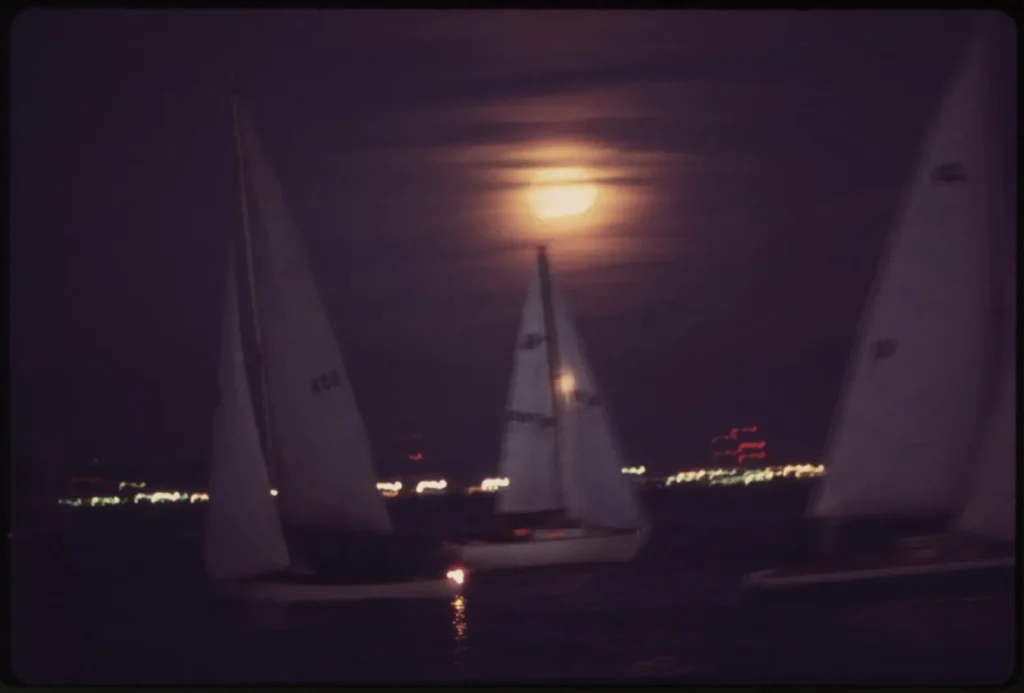
Your own navigation lights
Navigation lights tell other vessels what you are and which way you are heading. Under the COLREGs:
- Sidelights: red to port and green to starboard.
- Sternlight: white, shining aft.
- Masthead (steaming) light: white, shining forward, shown by power-driven vessels. A sailing yacht under engine is a power-driven vessel and must show it.
- Tricolour: sailing vessels under 20 metres may combine their sidelights and sternlight in one lantern at the masthead, but only when sailing, not when motoring.
Before departure, test every light and carry spare bulbs or a backup lantern. This is part of our pre-departure inspection checklist.
Reading other vessels’ lights
At night, the pattern of lights tells you a vessel’s type, size and direction:
- A red and a green light together means a vessel heading straight towards you.
- Two white masthead lights, one higher than the other, indicate a large power-driven vessel of 50 metres or more. The lower light is forward, which shows its heading.
- Special combinations, such as red over white for fishing vessels or red-white-red for vessels restricted in their ability to manoeuvre, show vessels you should keep clear of.
Busy areas such as the English Channel and the Strait of Gibraltar have heavy night traffic. See our guides to traffic separation schemes and the English Channel and North Sea.
Collision avoidance at night
- Keep a proper lookout by sight, by hearing and with all available means, as the COLREGs require.
- Take compass bearings: if the bearing of an approaching light stays steady while the range closes, there is a risk of collision.
- Act early and clearly: a large alteration of course made in good time is easier for the other vessel to see than small changes.
- Use AIS and radar: AIS shows the name, course and closest point of approach of most commercial ships, and radar detects vessels without AIS. Read how AIS tracking works.
- Call on VHF if the situation is unclear. Many bridge watches respond quickly to a clear call.
Protecting night vision
The human eye needs roughly 20–30 minutes to adapt fully to darkness, and one bright white light can undo it in seconds. Delivery crews use red head torches, dim instrument displays and switch chartplotters to night mode. More on night vision.
Watch routines and fatigue
A night passage depends on a watch system that gives everyone real rest. Typical set-ups are three- or four-hour watches, with a clear handover covering course, traffic, weather and anything unusual. The skipper sets standing orders, such as when to call them. Read more in crew size and watch systems and a day on a yacht delivery.
Safety on deck at night
- Lifejackets with lights and personal AIS beacons should be worn on deck at night.
- Crew should clip on to jacklines before leaving the cockpit, and nobody should go forward without telling the watch.
- Reef early, before dark, so sail changes are not needed in the middle of the night.
Falling overboard at night is one of the most serious risks at sea. Our man overboard guide and the offshore safety equipment checklist cover the essentials.
Night passages with Nordic Crew Worldwide
Our Scandinavian captains hold professional Master certificates, and night watchkeeping is a normal part of their work. If you are planning a delivery, read how to choose a yacht delivery skipper or see our quote guide.
Related guides
- Heavy weather tactics on a yacht delivery
- Fire safety on board a yacht
- How long does a yacht delivery take?
- Thunderstorm and squall safety
Frequently asked questions
What lights must a sailing yacht show at night?
Red and green sidelights and a white sternlight. Under 20 metres they may be combined in a masthead tricolour when sailing. When motoring, a sailing yacht must also show a white masthead (steaming) light and may not use the tricolour.
How do you tell if a ship is heading towards you at night?
If you see both its red and green sidelights, it is heading towards you. Large ships also show two white masthead lights, and when they line up vertically the ship is pointing at you.
How long does it take for eyes to adjust to the dark?
Roughly 20–30 minutes for full dark adaptation. That is why delivery crews use red lights and dim displays at night.
Is it safe to sail at night on a yacht delivery?
Yes, with a proper watch system, correct lights, AIS and radar, and safety routines such as lifejackets and clipping on. Night sailing is a normal part of most deliveries.