
Short answer: before an offshore delivery, a yacht should carry — and the crew should check — a serviced life raft for everyone on board, a registered 406 MHz EPIRB, lifejackets with harnesses, lights and crotch straps, jackstays and tethers, in-date flares, a DSC VHF and offshore communications, fire and flooding equipment, a grab bag, a proper medical kit and heavy-weather and emergency steering gear. The international benchmark is World Sailing’s Offshore Special Regulations; your flag state’s rules and insurer may add requirements.
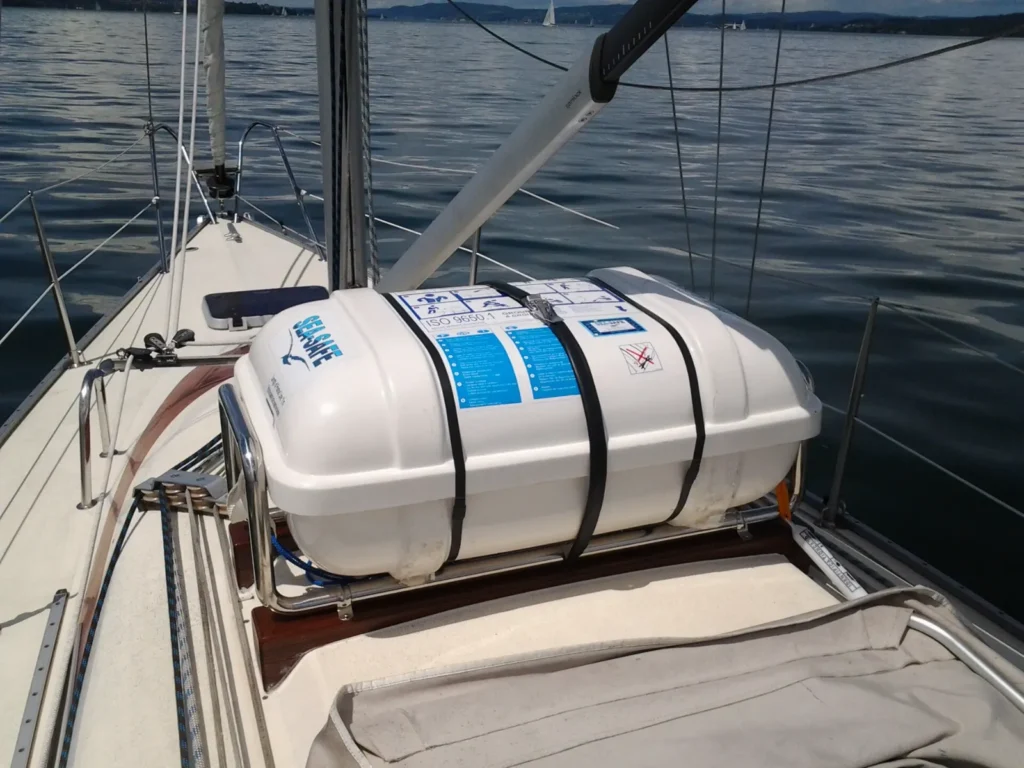
Safety equipment is the first thing a professional delivery skipper checks — and the most common reason a departure is delayed. This checklist shows what we expect to find on board for an offshore passage, and what we check on each item. Owners can use it to prepare the yacht before the crew arrives.
Which standard applies?
World Sailing’s Offshore Special Regulations (OSR) are written for racing but are widely used as a benchmark for offshore cruising and deliveries. They group passages into categories, from Category 0 (trans-ocean, far from rescue) to short coastal races. A typical delivery across the Bay of Biscay or between Gibraltar and the Canaries corresponds roughly to Category 1–2; an Atlantic crossing approaches Category 0–1. Commercially operated yachts may also fall under national codes, such as the UK’s small commercial vessel code. The table below is a practical summary, not a substitute for the rules.
The checklist
| Equipment | Offshore requirement (typical) | What we check |
|---|---|---|
| Life raft | Capacity for everyone on board, offshore/ISO 9650 type | Service date, secure mounting, hydrostatic release or quick-release, painter attached |
| EPIRB (406 MHz) | One, with GPS, registered to the yacht | Registration, battery and hydrostatic release expiry, self-test |
| Personal locator beacons / AIS MOB beacons | One per crew member offshore | Battery, fitted to lifejackets, registered where required |
| Lifejackets | Automatic inflation, integrated harness, light, sprayhood, crotch strap | Cylinder and auto-firing head in date, service date, fit |
| Jackstays and tethers | Bow-to-stern jackstays; tethers with safety hooks | Strength of attachment points, wear, UV damage |
| Man-overboard gear | Lifebuoy with light and drogue, throwing line, recovery system | Ready to deploy from the helm; crew briefed |
| Flares | Parachute, handheld and smoke flares (or approved alternatives) | Expiry dates, waterproof container, local rules for disposal |
| VHF radio | Fixed DSC VHF with MMSI, plus a waterproof handheld | MMSI programmed, GPS connected, antenna and backup antenna |
| Offshore communications | Satellite phone or messenger for weather and contact | Subscription active, weather files working |
| AIS | Transponder (Class B or better) recommended | Transmitting, correct MMSI and vessel data |
| Fire | Extinguishers by engine, galley and accommodation; fire blanket | Pressure and service dates, accessible locations |
| Flooding | Manual bilge pumps operable from deck and below, buckets, softwood plugs | Pumps tested, strum boxes clear, plugs tied at each through-hull |
| Grab bag | Waterproof bag for abandoning ship | Handheld VHF, PLB, water, first aid, torch, documents copies |
| Medical | Offshore first-aid kit matched to the passage length | Contents, expiry dates, medical guide, crew training |
| Heavy weather | Storm jib and trysail or deep reefs; drogue for long passages | Sails bent on or ready, reefing lines rigged |
| Emergency steering | Emergency tiller or alternative method | Fits, tested, crew knows where it is |
| Navigation | Up-to-date charts, backup GPS, compass, navigation lights | Charts for the whole route, lights tested, deviation checked |
| Radar reflector | Passive or active reflector | Mounted high, undamaged |
The safety briefing
Equipment only works if the crew knows how to use it. Before every delivery our skipper runs a safety briefing: where everything is, how to launch the life raft and activate the EPIRB, the man-overboard procedure, fire and flooding drills, when harnesses are worn (always at night and in rough weather), and the watch system.
Common problems we find
- Life rafts years past their service date
- EPIRBs not registered, or registered to a previous owner
- Lifejacket cylinders loose or auto-inflation heads expired
- Flares out of date
- Jackstays missing, or attached to weak fittings
- No way to operate the bilge pump from the cockpit
- Emergency tiller that does not fit
Fixing these before the crew arrives saves days. If the yacht cannot meet the standard for the passage, we will say so — and suggest what to hire, service or buy.
Communication and position updates
On a delivery, communication is part of safety. We agree with the owner how often they receive position reports, carry satellite communication for weather and emergencies offshore, and file a passage plan with a shore contact. Read about weather routing on a yacht delivery.
Insurance and safety equipment
Many insurers require specific equipment and crew numbers for offshore passages. Missing or expired safety gear can affect a claim. See our insurance guide.
Safety first on every Nordic Crew delivery
Our captains and officers come from the commercial fleet, where drills, inspections and safety management are routine. We bring that discipline to every yacht. See the full yacht delivery preparation checklist, read about choosing a delivery skipper, or request a free quote.
Related guides
- How to prepare your yacht for delivery
- Crossing the Bay of Biscay
- Mediterranean to Caribbean yacht delivery
- Pre-departure yacht inspection
Frequently asked questions
What safety equipment does a yacht need for an offshore delivery?
A serviced life raft for everyone on board, a registered 406 MHz EPIRB, lifejackets with harnesses and lights, jackstays and tethers, in-date flares, a DSC VHF and offshore communications, fire and flooding equipment, a grab bag, a medical kit, and heavy-weather and emergency steering gear.
What are the World Sailing Offshore Special Regulations?
International safety rules for offshore sailing races, grouped into categories by how far a passage goes from shelter and rescue. They are widely used as a benchmark for offshore cruising and deliveries.
How often must a life raft be serviced?
At the interval set by the manufacturer, typically every one to three years. A raft past its service date may not inflate correctly and can affect insurance cover.
Does an EPIRB need to be registered?
Yes. A 406 MHz EPIRB must be registered with the national authority of the flag state, with the current owner and vessel details, so rescue services can identify the yacht.