
Scotland is a natural crossroads between Scandinavia, the North Sea and the Atlantic. Owners move boats here for the spectacular west coast cruising grounds, and many yachts heading from the Baltic to Ireland or the Atlantic pass through Scottish waters. A yacht delivery to Scotland often includes one of Europe’s most famous inland shortcuts: the Caledonian Canal. This guide covers the main routes, the canal and the tides to plan for.
Common routes to and from Scotland
Distances are approximate and depend on the exact ports and the weather.
- Norway – Scotland: from Bergen to Inverness is roughly 330–360 nm across the northern North Sea. Our Norway yacht delivery guide covers the Norwegian side.
- Denmark – Scotland: from Skagen to Inverness is around 470–500 nm. See our Denmark yacht delivery guide and the Baltic and Scandinavia guide.
- Scotland – Ireland: the west coast leads south through the North Channel. Read our Ireland yacht delivery guide.
- Scotland – English Channel and Europe: down the east coast and the southern North Sea. See English Channel and North Sea delivery.
The Caledonian Canal: a shortcut across Scotland
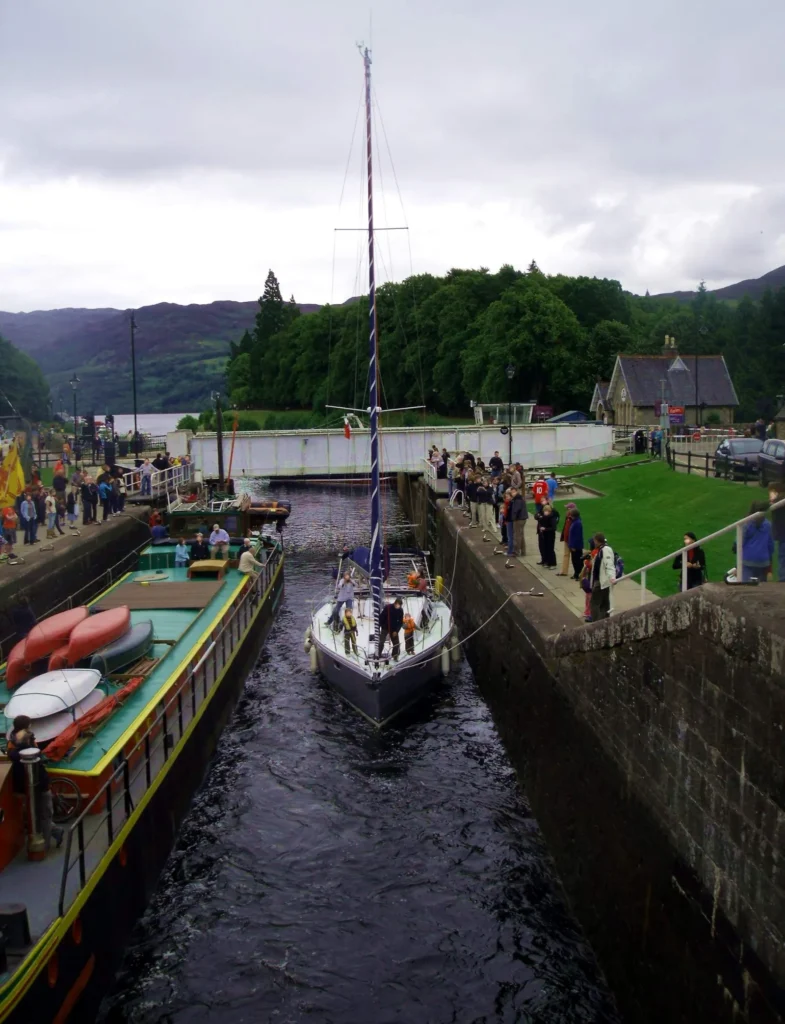
The Caledonian Canal connects Inverness on the east coast with Corpach near Fort William on the west coast. It runs about 60 miles (100 km), and only around a third of it is man-made. The rest follows Loch Ness, Loch Oich, Loch Lochy and Loch Dochfour.
- 29 locks, including the eight-lock flight of Neptune’s Staircase at Banavie, the longest staircase lock in Britain.
- The summit is Loch Oich, about 32 metres above sea level.
- Loch Ness gives more than 20 miles of open water, which can build a steep chop in strong south-westerly or north-easterly winds.
The canal saves the long and exposed passage around the north of Scotland via the Pentland Firth and Cape Wrath. Most yachts take two to four days through, depending on lock opening hours, other traffic and the weather on the lochs. Locks are operated by canal staff, so passages follow their timetable. Check the current size limits, opening hours and licence requirements with Scottish Canals before planning.
If you are used to the Göta Canal or the Kiel Canal, expect a slower, more scenic transit with frequent lock work. Fenders and long lines on both sides are essential.
The Pentland Firth and northern route
Boats that are too large for the canal, or that come from Shetland or Orkney, go around the north. The Pentland Firth between Orkney and the Scottish mainland has some of the strongest tidal streams in Europe. Wind against tide can create dangerous overfalls. The passage must be timed carefully with the tide tables, and a delivery crew plans an alternative if the window closes.
West coast: the Crinan Canal and the Hebrides
On the west coast, the 9-mile Crinan Canal links the Firth of Clyde with the Sound of Jura and avoids the exposed Mull of Kintyre. Further north, strong tidal gates and Atlantic swell make passage planning just as important as on the east coast.
Weather and season
- The main season for deliveries is late spring to early autumn. From October, Atlantic depressions become more frequent and daylight shorter.
- North Sea crossings need a stable weather window; see weather routing for yacht deliveries.
- Read our heavy weather tactics and the winter delivery guide if the move is late in the year.
Plan your Scotland delivery with Nordic Crew Worldwide
Our Scandinavian captains plan northern deliveries around tides, weather windows and canal opening times. Tell us the boat, the dimensions and the dates, and we will plan the best route, through the canal or around the north. Our quote guide shows what to send, and yacht delivery cost explains the price factors.
Related guides
- How long does a yacht delivery take?
- How to prepare your yacht for delivery
- Yacht delivery documents checklist
- UK to Europe yacht delivery after Brexit
Frequently asked questions
How long is the Caledonian Canal?
The Caledonian Canal runs about 60 miles (100 km) from Inverness to Corpach near Fort William. Only about a third is man-made; the rest follows Loch Ness, Loch Oich, Loch Lochy and Loch Dochfour.
How many locks are on the Caledonian Canal?
There are 29 locks, including the eight-lock Neptune’s Staircase at Banavie, the longest staircase lock in Britain.
How long does it take to go through the Caledonian Canal by yacht?
Usually two to four days, depending on lock opening hours, traffic and the weather on Loch Ness and the other lochs.
Is the Pentland Firth dangerous for yachts?
It has some of the strongest tidal streams in Europe, and wind against tide can create dangerous overfalls. With correct tidal timing and a good weather window it can be passed safely.