
Trawler yachts are built for long, economical passages rather than speed. That makes them some of the most rewarding boats to move over long distances, but a trawler yacht delivery needs different planning from a fast planing motor yacht or a sailing yacht. This guide explains what matters: speed, range, stability, weather and route choice.
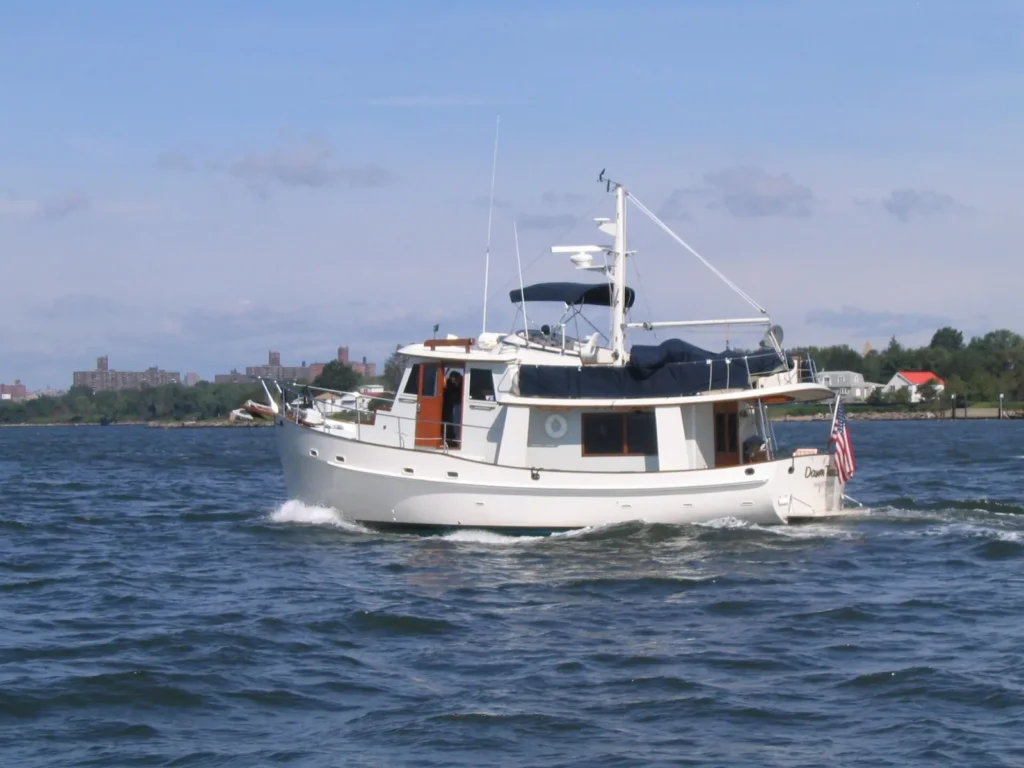
What makes a trawler different
A recreational trawler usually has a full or semi-displacement hull, a large fuel capacity and one or two economical diesel engines. Instead of climbing onto the plane, the hull moves through the water and is limited by its hull speed. A common rule of thumb is about 1.34 × √(waterline length in feet) knots. For a trawler with a 40-foot waterline that is around 8.5 knots.
The result is a boat that may be slow on paper but can keep going day and night with modest fuel burn. Read our comparison of motor yacht and sailing yacht deliveries for the wider picture.
Speed and passage time
At 7–9 knots, a trawler covers roughly 170–215 nautical miles in 24 hours of continuous running. Delivery planning is therefore based on watch systems and non-stop legs rather than daylight hops. Examples:
- A 600 nm passage is about three days of continuous running at 8 knots, plus weather margin and stops.
- A longer route such as Scandinavia to the Mediterranean is planned in legs with fuel and rest stops.
See how long a yacht delivery takes and our article on crew size and watch systems.
Fuel range and reserves
Many trawlers have a long theoretical range, but published figures usually assume calm water, a clean hull and an economical speed. On a delivery we plan with real margins:
- Measure actual fuel burn on the first leg instead of relying on brochure figures.
- Keep a substantial reserve, often around a third of the fuel, for headwinds, detours and waiting off a harbour.
- Check fuel quality and filters before departure. Long-stored fuel in large tanks is a known risk, see our guide to diesel bug and fuel contamination.
Our motor yacht fuel range planning guide explains the calculation in more detail.
Stability, rolling and stabilisers
Round-bilged displacement hulls can roll heavily in a beam sea. Many trawlers have active fin stabilisers, and some have paravanes or flopper-stoppers. Before departure the crew should check:
- That stabilisers work and that any alarms or hydraulic systems are serviced.
- That loose items, furniture and the tender are secured for sustained rolling.
- Weight distribution and tank levels, which affect stability as fuel is used.
Weather windows
A trawler cannot outrun weather, so the window has to cover the whole leg. Head seas slow a displacement boat sharply, and beam seas make it roll. In areas such as the Bay of Biscay, the North Sea or the Gulf of Lion, waiting for the right window is part of the job. Read crossing the Bay of Biscay and heavy weather tactics on a delivery.
Single engine, get-home systems and spares
Many trawlers have a single main engine, sometimes with a small wing engine or hydraulic get-home drive. A careful delivery includes:
- A test run of any get-home system before departure.
- Spare filters, impellers, belts and enough engine oil for the passage.
- Regular engine room checks on every watch.
Our pre-departure inspection checklist covers the full list.
Inland waterways: an option for some trawlers
Because they have no mast and often a moderate draft, some trawlers can use the French canals between the Channel and the Mediterranean. Air draft, draft and length must fit the route restrictions. Our guide to the French canals explains the limits.
Trawler deliveries with Nordic Crew Worldwide
Our Scandinavian captains plan every trawler delivery around these factors, whether the route runs through the North Sea, the Baltic or the Mediterranean. If you are moving an older trawler, also read delivering an older or classic yacht. To get a price, see what a yacht delivery costs.
Related guides
Frequently asked questions
How fast is a trawler yacht on a delivery?
Most trawlers cruise at about 7–9 knots, limited by their hull speed. Running day and night, that is roughly 170–215 nautical miles in 24 hours.
How much fuel reserve should a trawler keep on a delivery?
A common approach is to keep around a third of the fuel in reserve and to measure the real fuel burn on the first leg, rather than relying on brochure range figures.
Can a trawler yacht go through the French canals?
Often, yes, because trawlers have no mast. The boat’s air draft, draft and length must fit the restrictions of the chosen canal route.
Do trawlers roll a lot at sea?
Round-bilged displacement hulls can roll in a beam sea. Stabilisers reduce this, and good weather routing keeps the boat out of the worst conditions.