
Short answer: the French canals let a yacht travel from the English Channel to the Mediterranean without crossing the Bay of Biscay or sailing around Spain. The mast comes down near the start, often around Le Havre or Rouen; the yacht motors up the Seine through Paris and along a chain of canals to the Saône and the Rhône; and the mast goes back up near Port-Saint-Louis-du-Rhône. The route suits yachts with a draft of about 1.5–1.8 m or less, a beam under about 5 m and a reliable engine. Expect around three to five weeks, much of it spent in locks.
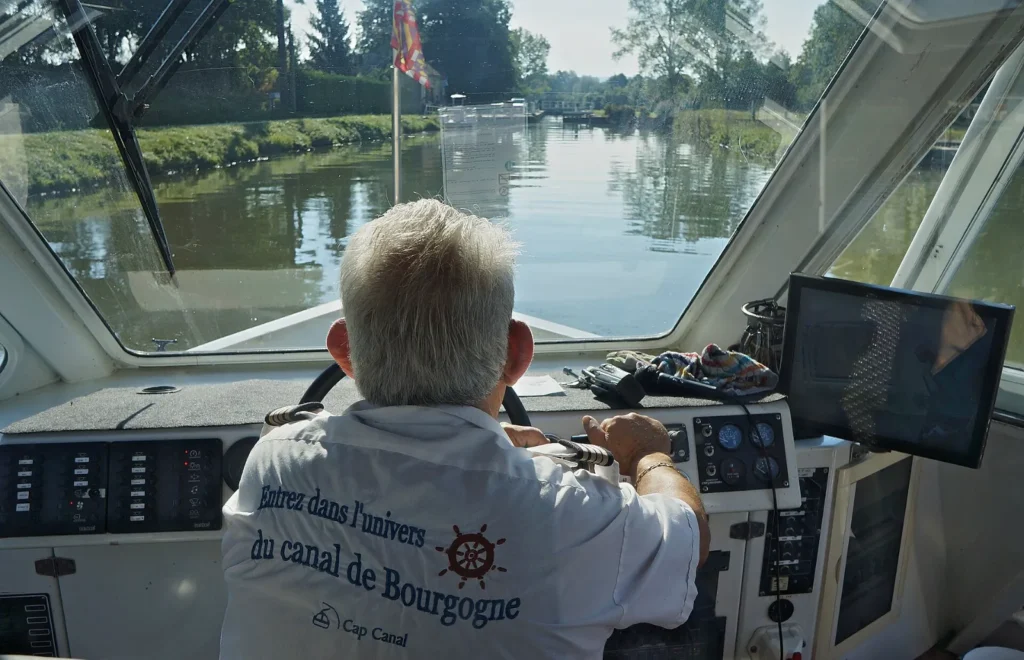
For owners in Northern Europe, this mast-down route is a real alternative to the long sea passage south. It works well for smaller sailing yachts and motor yachts, older boats and owners who want to avoid the open Atlantic in autumn. It is not right for every yacht, though — this guide explains when it works, and when the sea route is the better choice.
The main inland routes to the Mediterranean
| Route | Main waterways | Good to know |
|---|---|---|
| Bourbonnais route | Seine, Canal du Loing, Canal de Briare, Canal latéral à la Loire, Canal du Centre, Saône, Rhône | The route most yachts use, with generally the most reliable depths |
| Burgundy route | Seine, Yonne, Canal de Bourgogne, Saône, Rhône | Very scenic, but the summit tunnel and shallower sections limit draft and air draft |
| Eastern routes | From Belgium or the Netherlands via the Meuse or the Moselle to the Saône | Useful when starting from the Low Countries or Germany; longer |
| Canal des Deux Mers | Garonne, Canal de Garonne, Canal du Midi to Sète | Links Bordeaux on the Atlantic to the Mediterranean; tight limits on length, draft and air draft |
Size limits: will your yacht fit?
- Beam: most locks on the smaller canals follow the Freycinet standard of about 38.5 × 5.05 m, so a beam of about 5 m is the practical maximum. Most cruising catamarans are too wide.
- Draft: official depths on the main routes are typically around 1.8 m, but silt and low water in summer often reduce them. A draft of 1.5 m or less gives a comfortable margin.
- Air draft: with the mast lying on deck, bridges and tunnels on the main routes usually allow around 3.4–3.5 m, less on some canals. Measure the highest point of the yacht, including the mast on its supports.
- Length: yachts up to about 30 m fit the Freycinet locks; the Canal du Midi has shorter locks.
Depths and closures change every season, so we check the current figures with Voies navigables de France (VNF) for the exact route before every canal delivery.
Taking the mast down
The mast is unstepped by crane at a yard or marina before the first lock — common places are around Le Havre, Honfleur and Rouen on the Seine. It travels on deck on padded wooden supports at the bow, the middle and the stern, strapped so it cannot move when the yacht is pushed around in a lock. The standing rigging is labelled and the furler protected. At the other end, yards around Port-Saint-Louis-du-Rhône and Port Napoléon step the mast again and tune the rig. Some owners prefer to send the mast separately by road.
Paperwork and rules on French waterways
- A VNF navigation licence (vignette) is needed for motorised boats on most French waterways. It can be bought online for different periods.
- The skipper needs a recognised inland qualification — for many foreign skippers, the International Certificate of Competence (ICC) with the inland (CEVNI) endorsement.
- The European inland rules (CEVNI) and local speed limits apply, often around 6–8 km/h on the canals.
- Locks have operating hours, and some sections close for maintenance in winter or during droughts.
The Rhône: the final stretch
South of Lyon, the Rhône is a big river with large commercial locks and a strong current, especially after heavy rain or snowmelt. Yachts travel downstream with the current, which shortens the trip, but the approaches to the locks and high water demand care. The Mistral can also blow hard down the valley; our guide to Mediterranean winds explains why.
How long does it take?
Allow about three to five weeks from the Channel to the Mediterranean, depending on the route, the number of locks per day, closures and how many hours the crew can travel each day. Locks work in daylight, so there is no travelling at night. For comparison with the sea route, see our guide to delivery times.
Canals or sea: which is better?
| French canals | Sea route via Biscay | |
|---|---|---|
| Best for | Shallow-draft yachts, older boats, autumn moves | Deep-draft yachts, catamarans, tight deadlines |
| Weather risk | Low: river conditions, with the Mistral at the end | Depends on weather windows in Biscay and off Iberia |
| Size limits | Beam about 5 m, draft about 1.5–1.8 m | None in practice |
| Extra costs | Unstepping and stepping the mast, cranes, licence | Fuel, marinas and a longer offshore passage |
| Wear on the yacht | Engine hours; hull and fenders rubbing in locks | Sails, rigging and engine |
| Orca encounters | None | Possible off Spain and Portugal |
Read more about the sea route from Scandinavia, crossing Biscay and orca encounters off Iberia.
Delivering your yacht through the French canals
Nordic Crew Worldwide plans both routes and helps owners choose the right one. For a canal delivery we handle the mast logistics, the licence, the locks and the re-rigging in the south. Request a quote for your route or see what our services include.
Related guides
- Mediterranean yacht delivery routes
- Wintering your yacht in the Mediterranean
- North Sea and English Channel yacht delivery
Frequently asked questions
Can a sailing yacht go through the French canals to the Mediterranean?
Yes, with the mast down. Most yachts with a draft of about 1.5–1.8 m or less, a beam under about 5 m and a reliable engine can use the inland route from the English Channel to the Mediterranean.
What is the maximum draft for the French canals?
Official depths on the main routes are typically around 1.8 m, but low water and silt often reduce them. A draft of 1.5 m or less is much more comfortable. Always check current figures with VNF.
Can a catamaran go through the French canals?
Usually not. The locks on most of the smaller canals are about 5 m wide, which is narrower than most cruising catamarans.
How long does the French canal route take?
Typically three to five weeks from the Channel to the Mediterranean, depending on the route, the number of locks, closures and daylight hours.