Short answer: a yacht delivery from the Netherlands can go two ways. Sailing yachts can follow the Staande Mastroute (standing mast route) through Dutch inland waters with the mast up, or head straight out to sea from IJmuiden or Den Helder and follow the North Sea coast. Motor yachts bound for the Mediterranean can also take the rivers and canals through Belgium and France. The right choice depends on the yacht’s draught and air draught, the season and how fast the owner needs her at the destination.
The Netherlands is one of Europe’s biggest markets for yachts. Yards around the IJsselmeer and in Friesland build motor and sailing yachts for the whole continent, and a large share of Europe’s used boats are sold through Dutch brokers. That makes the Netherlands one of the most common starting points for a delivery — to Scandinavia, to the UK or south to the Mediterranean.
Option 1: the standing mast route
The Staande Mastroute is a network of canals, lakes and rivers with opening bridges that lets sailing yachts cross the country without lowering the mast. It links the Wadden Sea and the IJsselmeer in the north with Zeeland in the south-west, via Amsterdam, Haarlem, Gouda and Dordrecht, so a yacht can travel north–south in sheltered water whatever the weather on the North Sea.
- Bridge opening times: most bridges open on schedule or on request, but many stay closed during the morning and evening rush hours and some do not open at night. A good day covers fewer miles than you might expect.
- The Amsterdam night passage: yachts with an air draught over 6.90 metres may only pass through Amsterdam at night, in a convoy through a series of bridges, and need an Amsterdam inland waterways vignette bought in advance. Waternet has reported the route temporarily closed because the Schinkel bridges on the A10 could not open, so we check the current status before every delivery that plans to use it.
- Draught and depth: the main route is dredged for typical cruising yachts, but deep-keel yachts need to check the depth on each section, especially in dry summers.
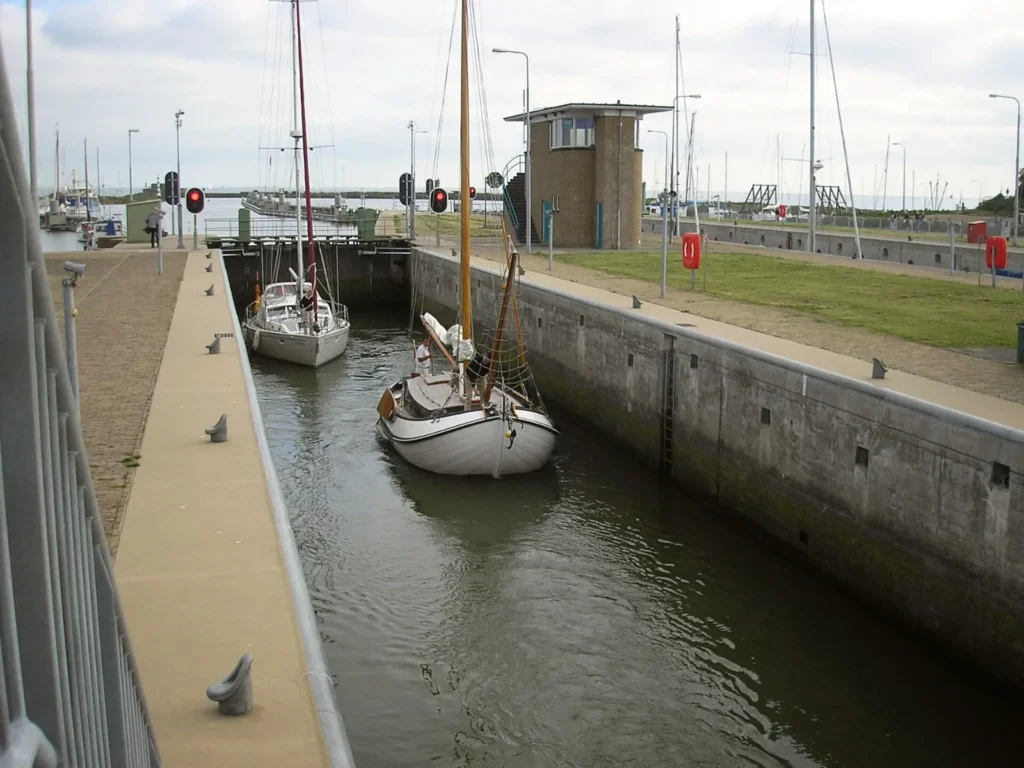
- Locks: the route passes several locks, including those in the Afsluitdijk at Kornwerderzand and Den Oever between the IJsselmeer and the Wadden Sea.
The standing mast route is slower than the sea route, but it avoids the exposed Dutch coast and is often the best choice in spring and autumn, when North Sea gales are frequent.
Option 2: straight out to the North Sea
For an offshore-capable yacht and a professional crew, the fastest route is usually to leave through the locks at IJmuiden or from Den Helder and sail directly along the coast. Heading south-west, the route continues through the Dover Strait and the English Channel; heading north, it crosses to Denmark and on into the Baltic through the Kiel Canal. The Dutch coast has few harbours of refuge that are safe to enter in strong onshore winds, so the timing of each leg depends on the forecast. Our North Sea and Channel guide covers the tides, traffic separation schemes and stopovers.
Option 3: motor yachts via the rivers and canals
Many Dutch-built motor yachts are designed for inland waters, with a low air draught and a modest range. For a yacht like this, the rivers and canals through Belgium and France can be a safer and more comfortable way to reach the Mediterranean than the Bay of Biscay. Our guide to the French canals explains the route, the dimensions and the fees.
Rules on Dutch inland waters
- Skipper licence: a recognised licence is required for yachts of 15 metres or more, or that can go faster than 20 km/h — in the Netherlands, the Klein Vaarbewijs or an equivalent recognised qualification.
- VHF with ATIS: a VHF radio used on Dutch and other European inland waters must transmit an ATIS identification code, which is not the same as the MMSI used at sea.
- Inland navigation rules: the inland rules (BPR, based on the European CEVNI code) apply instead of the international collision regulations, and many bridges and locks are worked on dedicated VHF channels.
Buying a yacht in the Netherlands
If you are buying through a Dutch broker, plan the delivery as part of the purchase: agree on a handover date that leaves time for a survey and a short sea trial, and make sure the yacht’s documents, VAT status and insurance are ready before departure. Our guides to buying a yacht abroad and preparing a yacht for delivery have checklists for both.
Yacht delivery from the Netherlands with Nordic Crew Worldwide
Our Scandinavian captains know the Dutch inland waters, the North Sea and the routes on to Scandinavia and the Mediterranean. We choose between the inland and offshore routes together with you, based on the yacht and the forecast, and all deliveries are covered by our own professional skipper insurance. Request a quote for a delivery from the Netherlands.
Related guides
Frequently asked questions
What is the standing mast route in the Netherlands?
A network of canals, lakes and rivers with opening bridges that lets sailing yachts cross the Netherlands between the Wadden Sea and Zeeland without lowering the mast.
Can a sailing yacht pass through Amsterdam with the mast up?
Yes, but yachts with an air draught over 6.90 metres may only pass at night in a convoy, with an Amsterdam waterways vignette. The night passage can close for bridge works, so check its status first.
Is it faster to deliver a yacht from the Netherlands by sea?
Usually. For an offshore yacht, leaving from IJmuiden or Den Helder and following the coast is faster than the inland route, but it depends more on the North Sea weather.
Do I need a licence to skipper a yacht on Dutch inland waters?
For yachts of 15 metres or more, or that can go faster than 20 km/h, a recognised licence such as the Dutch Klein Vaarbewijs is required.